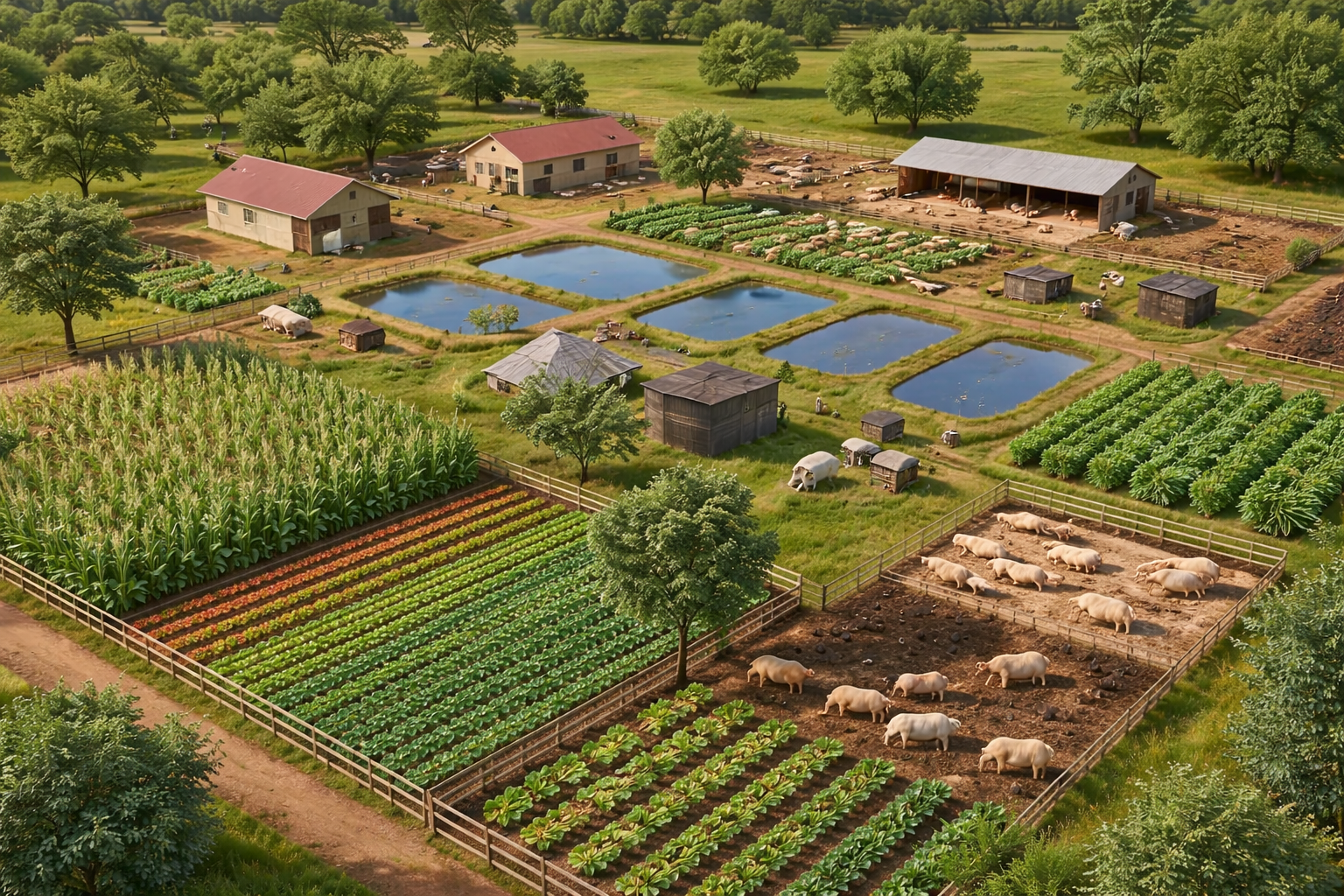
Mixed Farming

Our mixed farming model combines crop production and livestock management into a balanced, resilient agricultural system.

By integrating these operations, we improve land productivity, support soil health, and deliver sustainable year-round output.

We focus on practical implementation, resilient farm management, environmentally responsible farming, and long-term environmental stewardship.

Mixed Farming

We integrate crop and livestock systems to improve resilience, resource efficiency, and farm productivity across seasons.

Our approach helps reduce dependency on external inputs while maintaining commercially strong and environmentally balanced outcomes.

Back to Services
Sri Vidyalaya PU College mixed farming services

Integrated Crop & Livestock Systems

Mixed farming is built on the principle that crops and livestock support one another.

Livestock contribute organic nutrients that enhance soil fertility, while crop rotations improve grazing systems and land balance. This natural integration reduces waste, strengthens soil biology, and increases operational efficiency.

At Sri Vidyalaya PU College, we design structured integration strategies that maximize land productivity while reducing environmental strain.

Our planning approach supports sustainable agricultural systems with practical implementation across diverse land conditions.

Each system is carefully planned to align with:

  • Soil type and land capability
  • Seasonal production cycles
  • Livestock management capacity
  • Long-term sustainability goals

Key Benefits of Mixed Farming

Soil Health Improvement

Natural nutrient recycling enhances soil structure, improves organic matter levels, and strengthens long-term fertility.

Diversified Revenue

Combining livestock and crop production reduces reliance on a single income source and improves financial resilience.

Year-Round Productivity

Balanced systems enable continuous and efficient land use across seasons.

Environmental Sustainability

Integrated systems reduce waste, promote biodiversity, and lower dependency on synthetic inputs.

Sustainable & Commercially Viable

Mixed farming is not only a traditional agricultural model — it is a forward-thinking agricultural strategy that strengthens resilience and operational stability.

Our structured planning ensures:

  • Long-term productivity growth
  • Risk diversification
  • Resource optimization
  • Measurable agricultural performance

Every system we design is tailored to land conditions, environmental objectives, and commercial goals.

We prioritize practicality, ensuring that sustainability and profitability work together — not in conflict.

Sri Vidyalaya PU College sustainable and commercial mixed farming